One move, repeated: drop a stone on an empty cell. From that tiny rule comes a game that mathematicians have studied for decades. Red wants a chain from top to bottom, Blue wants one from left to right, and the two paths can't both exist.
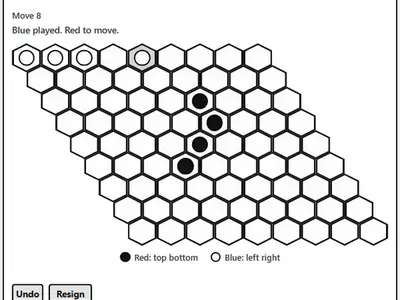
This Hex unblocked page uses a 9x9 diamond from Christopher Müller's PaperGames collection. Play the computer on one of three levels, or hand the device to a friend for a head-to-head match.
How to play Hex
Red always makes the first move. Then you take turns, each placing a single stone of your color on any open hexagon. Stones never slide and are never removed.
Red needs an unbroken string of red cells touching the top and bottom edges. Blue needs the same across the left and right edges. A hexagon has six neighbors, so chains can twist and turn. As soon as one side finishes a path, the game names the winner.
A draw is impossible, because any wall that stops one player's path is itself a winning path for the other. Before a game, choose Red or Blue and set the computer to Easy, Medium or Hard. A legend under the board reminds you which edges are yours.
Controls
| To… | Keyboard | Mouse | Touch |
|---|---|---|---|
| Place a stone | Tab to the board, arrow keys to pick a cell, Enter to place | Click an empty hexagon | Tap an empty hexagon |
| Choose color and opponent | — | Pick Red or Blue and a level, then click "New game" | Pick Red or Blue and a level, then tap "New game" |
| Take back a move | — | Click "Undo" | Tap "Undo" |
| Give up | — | Click "Resign" | Tap "Resign" |
Tips
- Open in the middle. A center stone can stretch toward either of your edges and is tough to cut off.
- Learn the bridge. Two stones with two shared empty cells between them are safely linked. If your rival takes one, take the other.
- Block from afar. A blocking stone right next to an enemy chain gets walked around. Get in the way a few rows ahead.
- Don't crawl along the edge. Edge stones do less work than central stones that threaten more than one route.
- Swap colors with a friend. Moving first is a real edge, and there is no swap rule, so trade sides each game.
Hex questions
How does each computer level play?
Easy chooses random cells. Medium measures how close each side is to connecting and picks among its better options. Hard looks several moves ahead, but only at the cells that seem most useful.
Is going first an advantage?
Yes. Red's first move is a real head start and there is no swap rule here, so take Blue if you want a tougher test.
Will my game be there if I reload?
Yes. The game in progress is kept in your browser on that device, so a reload picks up where you stopped.