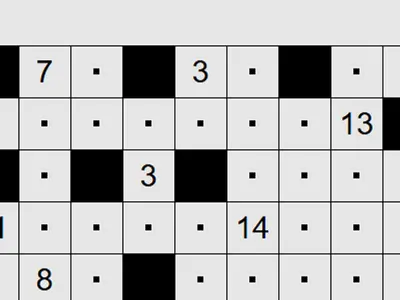
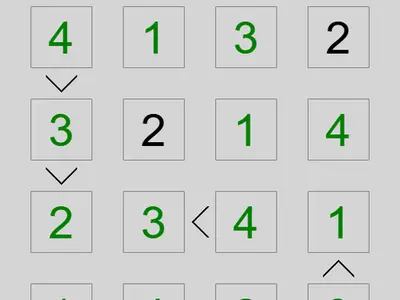
Picture a number grid where no row or column may repeat, but almost no numbers are given. Instead, little signs sit between some squares and tell you which neighbor is bigger. That is plenty to crack the whole board if you follow the logic carefully.
Greater-Than Grid unblocked is James Harvey's contribution to Simon Tatham's Portable Puzzle Collection. Alongside the sign version, it has an Adjacent mode where bars mark neighbors that differ by exactly one.
How to play Greater-Than Grid
An N by N grid uses the numbers 1 to N. No number may show up twice in any row or column. A 6x6 grid, for example, needs 1 through 6 in every line.
In the standard mode, a sign between two squares works just like in math class. Its wide side faces the larger number and its point faces the smaller. Tougher puzzles leave some signs out, and a few squares may start filled. In Adjacent mode, a bar means the two numbers are one apart, like 4 and 5, and every such pair has a bar, so a missing bar is a clue too.
Select a square and enter a number, or switch to pencil marks for small notes. The grid flashes when it is fully correct. Presets run from 4x4 up to 7x7 at several levels, and Custom lets you go bigger.
Controls
| To… | Keyboard | Mouse | Touch |
|---|---|---|---|
| Enter a digit | Arrow keys to move, then type the digit | Click a square, then type a digit | Tap a square, then tap a digit button |
| Add or remove a pencil mark | Enter switches the cursor to pencil mode, then type a digit | Right-click a square, then type a digit | Set Tap to Pencil mark (or press and hold a square), then tap a digit |
| Clear a square | Space, Backspace or 0 | — | Tap the square, then Clear |
| Fill in every possible pencil mark / also remove the obvious ones | M / H | — | — |
| Grey out a clue sign you have used | Shift or Ctrl + arrow key next to the clue | Click the sign | Tap the sign |
| New game, undo, redo | N, U, R | Menu buttons above the grid | Menu buttons above the grid |
Tips
- Use the extremes. The larger side of a sign can never be 1, and the smaller side can never be N.
- Follow sign chains. Three squares climbing in a row mean the bottom one is at most N minus 2.
- Find local lows. A square that is smaller than all its signed neighbors is often a 1 or 2.
- Let the M and H keys do the busywork. H fills in pencil marks and strips out the obvious clashes.
- Grey out used signs. Once both squares are solved, click the sign so the live clues stand out.
Greater-Than Grid questions
Is this a math game?
It is pure number logic. You only compare sizes and avoid repeats, so there is no arithmetic, but it trains the same careful reasoning.
What do the bars mean in Adjacent mode?
Bars connect squares whose numbers are consecutive. Every consecutive pair is marked, so two squares with no bar can never be one apart.
How do I play on a touchscreen?
Tap a square, then tap a number in the bar below the grid. Switch the tap mode to pencil marks, or press and hold a square, to add notes.